- Pondhouse Data OG - We know data & AI
- Posts
- Pondhouse Data AI - Tips & Tutorials for Data & AI 40
Pondhouse Data AI - Tips & Tutorials for Data & AI 40
Disney's $1B OpenAI Sora Deal | GPT5.2 for Pros | Cursors Visual React UI Editor | Efficent AI Apps with Semantic Caching

Andreas Nigg
16 Dec

Hey there,
This week’s edition is packed with some of the most exciting developments in AI and tech! We’re diving into the launch of OpenAI’s GPT-5.2, which is setting new benchmarks for professional AI performance, and exploring the innovative Cursor Visual Editor that’s transforming how React apps are built. You’ll also find a hands-on tutorial on semantic caching for LLMs in Python, plus practical tips on boosting code quality with repo-aware AI reviewers. From Disney’s billion-dollar bet on generative video to the debut of the Mistral 3 multimodal models, there’s plenty to keep you inspired and informed.
Let’s dive in!
Cheers, Andreas & Sascha
In today's edition:
📚 Tutorial of the Week: Semantic caching for faster Python LLMs
🛠️ Tool Spotlight: Cursor Visual Editor for React UIs
📰 Top News: OpenAI launches GPT-5.2 for professionals
💡 Tip: Repo-wide AI reviewers boost code quality
Let's get started!
Tutorial of the week
Accelerate LLMs with Semantic Caching in Python

Looking to make your AI agents faster and more cost-effective? DeepLearning.AI’s new short course, Semantic Caching for AI Agents, is a hands-on guide to building semantic caches that reuse LLM responses based on meaning—not just exact text. This practical resource is perfect for anyone aiming to reduce inference latency and operational costs in real-world AI systems.
Comprehensive, practical curriculum: Learn to build a semantic cache from scratch using Python and Redis, with step-by-step code examples and real-world scenarios.
Performance-driven approach: Master key metrics like cache hit rate, precision, recall, and latency, and discover advanced techniques such as cross-encoders, LLM validation, and fuzzy matching to maximize cache effectiveness.
Direct integration into AI workflows: See how semantic caching can be integrated into agent pipelines to minimize redundant API calls and deliver faster, smarter responses as your cache “warms up.”
Expert instruction: Taught by Tyler Hutcherson (Applied AI Engineering Lead) and Iliya Zhechev (Senior Research Engineer) from Redis, ensuring industry relevance and depth.
Free, accessible learning: The course is currently free during the DeepLearning.AI platform beta—ideal for developers and ML engineers familiar with Python, embeddings, and LLM basics.
If you’re building or optimizing AI agents and want to cut costs while improving user experience, this course is a must. Start building smarter, faster AI solutions today.

Tool of the week
Cursor Visual Editor — Real-Time, Code-Synced UI Editing for React Apps

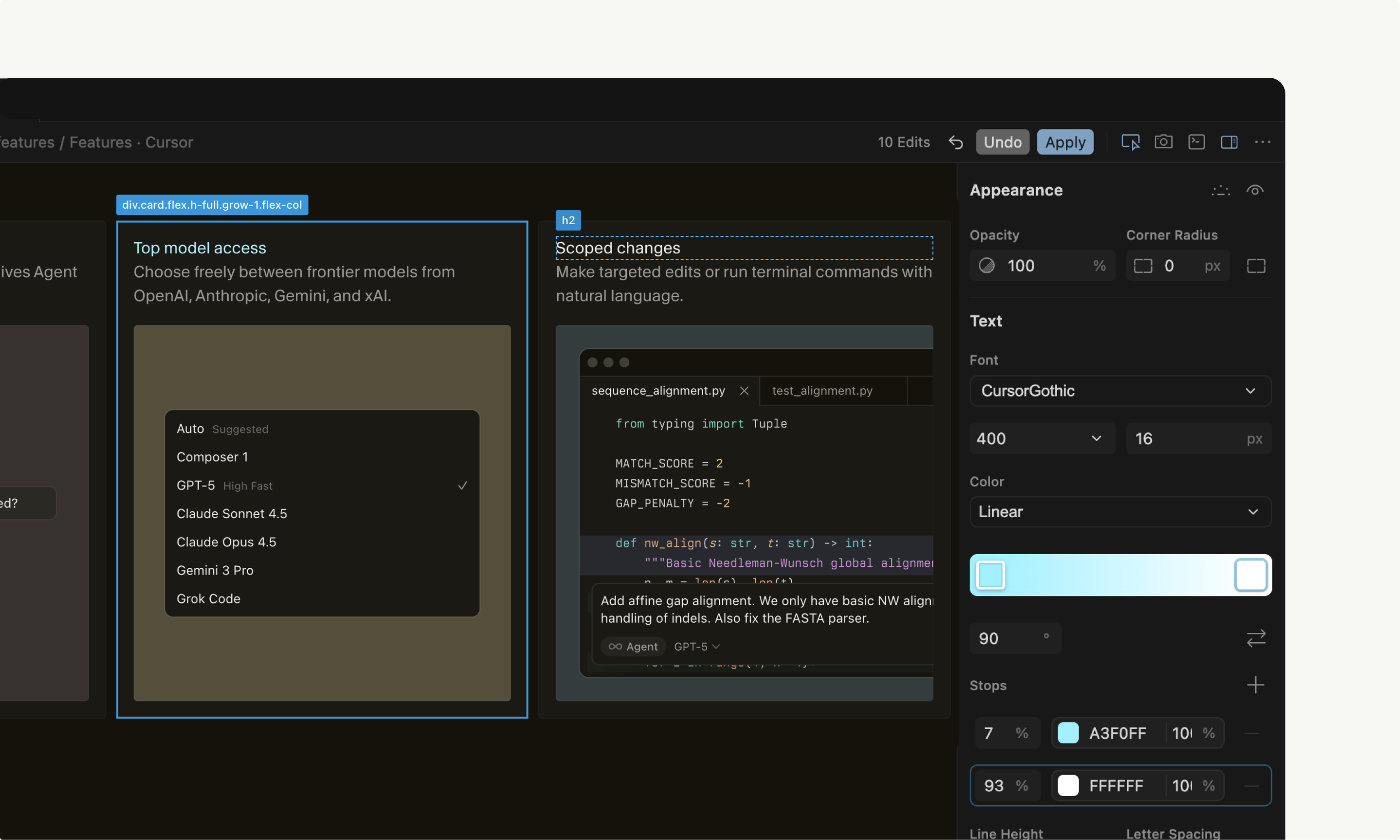
Cursor’s new Visual Editor revolutionizes frontend development by allowing developers to edit live React interfaces directly in the browser, with every visual change instantly reflected in the underlying codebase. This tool bridges the gap between design and implementation, enabling seamless drag-and-drop UI adjustments, property tweaks, and natural language prompts—all without leaving your development environment.
Drag-and-drop layout editing: Instantly rearrange elements in your app’s DOM tree, experiment with grid configurations, and reorder components visually—no manual code changes required.
Component state testing: Surface and modify React component props directly in the sidebar, making it easy to test different states and variants on the fly.
Precision visual controls: Fine-tune styles with interactive sliders, color pickers, and layout tools, fully integrated with your design system for pixel-perfect adjustments.
Point-and-prompt AI: Click any UI element and describe changes in plain language (e.g., “make this bigger” or “turn this red”). Multiple agents apply code updates in real time, streamlining iteration.
Unified design-to-code workflow: By merging visual editing and code, Cursor empowers teams to move faster, reduce context switching, and keep design and implementation perfectly in sync.
Already gaining traction among modern React teams, Cursor’s Visual Editor is a glimpse into the future of collaborative, AI-assisted frontend development.
Top News of the week
OpenAI Unveils GPT-5.2: Setting a New Standard for Professional AI Performance
OpenAI has announced the release of GPT-5.2, its most advanced AI model to date, designed to excel in professional workflows and agent reliability. GPT-5.2 demonstrates human-expert performance across a wide range of knowledge work tasks, achieving a 70.9% win-or-tie rate against industry professionals on the GDPval benchmark. The model brings significant improvements in reasoning, coding reliability, long-context understanding, and multi-tool workflow execution.

GPT-5.2 introduces specialized modes—Instant, Thinking, and Pro—each tailored for different levels of task complexity and accuracy requirements. The model sets new state-of-the-art results in software engineering (55.6% on SWE-Bench Pro), advanced mathematics, and scientific reasoning. Its enhanced long-context capabilities enable accurate analysis of documents up to 256,000 tokens, while vision and tool-calling features have also seen substantial upgrades. Early enterprise adopters report major productivity gains, with some collapsing multi-agent systems into a single, more reliable GPT-5.2-powered agent.
The rollout begins immediately for ChatGPT paid plans and is available via API, with pricing reflecting its increased capabilities. This release marks a pivotal step forward in AI’s ability to handle complex, real-world professional tasks, further bridging the gap between human and machine expertise.
Also in the news
Disney Invests $1B in OpenAI for Sora-Powered Fan Content
Disney and OpenAI have signed a landmark three-year agreement allowing Sora, OpenAI’s generative video platform, to create short, fan-prompted videos featuring over 200 characters from Disney, Marvel, Pixar, and Star Wars. As part of the deal, Disney will invest $1 billion in OpenAI and leverage its APIs to enhance Disney+ and internal tools. The partnership emphasizes responsible AI use, creator rights, and curated Sora content streaming on Disney+ starting in 2026.
Agentic AI Foundation Launches to Standardize AI Agent Protocols
The Linux Foundation has announced the formation of the Agentic AI Foundation (AAIF), co-founded by OpenAI, Anthropic, and Block. AAIF unifies key agentic AI standards—Anthropic’s MCP, Block’s goose, and OpenAI’s AGENTS.md—under a neutral governance structure. With major industry support from AWS, Google, Microsoft, and others, AAIF aims to drive open, interoperable agent development and ensure transparent, community-driven progress in autonomous AI systems.
Mistral 3 Family Debuts with 10 Open-Weight Multimodal AI Models
Mistral AI has released the Mistral 3 lineup, featuring ten new open-weight models ranging from 3B to 14B parameters, plus the flagship Large 3 model with 41B active and 675B total parameters. These models use a sparse Mixture-of-Experts architecture for efficient, high-capacity performance and support multilingual, multimodal tasks. All models are open source under Apache 2.0 and available via Mistral AI Studio, Hugging Face, and major cloud providers.
PaperDebugger Brings LLM Agents Directly into Academic Writing Editors
Researchers at the National University of Singapore have introduced PaperDebugger, a plugin-based system that embeds large language model agents directly into LaTeX editors like Overleaf. Unlike external assistants, PaperDebugger accesses document state, version history, and structure for context-aware editing, literature search, and revision workflows. The system uses a Chrome extension and Kubernetes backend, enabling seamless, multi-agent academic writing support within the editor.
Tip of the week
Boost Code Review Quality with Repo-Wide AI Reviewers
Tired of noisy, low-signal automated code reviews that miss context or flood you with false alarms? OpenAI’s latest Codex models show how repo-aware AI reviewers can dramatically improve code review precision and developer trust.
Leverage repo-wide context: Instead of reviewing just the code diff, Codex reviewers access the entire repository and can execute code, catching critical issues that diff-only tools miss.
Prioritize high-signal findings: Codex is optimized for precision over recall, surfacing only actionable, high-confidence issues—reducing review fatigue and false positives.
Easy integration: Use the
/reviewcommand in the Codex CLI or enable Code Review in Codex Cloud to auto-review PRs or trigger reviews on demand.Real-world impact: Over 50% of Codex review comments result in code changes, and the system is already catching launch-blocking bugs at scale within OpenAI and across thousands of external PRs daily.
For teams looking to scale code quality without slowing down, integrating repo-aware AI reviewers is a practical, high-leverage step.

We hope you liked our newsletter and you stay tuned for the next edition. If you need help with your AI tasks and implementations - let us know. We are happy to help