- Pondhouse Data OG - We know data & AI
- Posts
- Pondhouse Data AI - Tips & Tutorials for Data & AI 42
Pondhouse Data AI - Tips & Tutorials for Data & AI 42
Anthropic's AI Economic Index | Deterministic AI-to-UI with json-render | The 'Assistant Axis' for Safer AI | Vercel's Open-Source Agent Skills

Andreas Nigg
27 Jan

Hey there,
This week’s edition is packed with breakthroughs and practical tools for AI-driven development. We’re spotlighting Anthropic’s new Economic Primitives, which offer fresh metrics for tracking the real-world impact of AI, and their innovative Assistant Axis research for safer, more reliable LLM personas. On the engineering front, discover how Cursor’s agent best practices can transform your coding workflows, and explore Vercel’s json-render toolkit for building schema-safe, dynamic AI interfaces. Plus, don’t miss our tip on supercharging your agents with Vercel’s open-source Agent Skills. Let’s dive in!
Enjoy the read!
Cheers, Andreas & Sascha
In today's edition:
📚 Tutorial of the Week: Best practices for coding with agents
🛠️ Tool Spotlight: json-render for safe AI UI streaming
📰 Top News: Anthropic’s new AI economic primitives report
💡 Tip: Extend agents with Vercel’s open-source skills
Let's get started!
Tutorial of the week
Mastering Reliable Coding Agents
Looking to supercharge your development workflow with AI-powered coding agents? Cursor’s comprehensive guide, "Best Practices for Coding with Agents," is a must-read for anyone aiming to build robust, autonomous coding solutions. This resource distills proven strategies for structuring tasks, managing context, and leveraging advanced agent features to maximize productivity and code quality.
Covers agent harnesses, planning, and context management: Learn how to orchestrate instructions, tools, and user prompts for optimal agent performance, and discover the importance of detailed planning before code generation.
Practical workflows and extensibility: Explore real-world patterns like test-driven development, parallel agent execution, and extending agents with custom rules and skills for your domain.
Advanced debugging and review: Harness features like Debug Mode, automated code review, and architecture diagram generation to catch bugs and document systems efficiently.
Cloud and local agent orchestration: Seamlessly delegate tasks to cloud agents, manage multiple sessions, and integrate with tools like Slack and Datadog for end-to-end automation.
Actionable tips for teams: Includes advice on prompt engineering, iterative workflow optimization, and best practices for reviewing AI-generated code.
This guide is ideal for developers, engineering leads, and teams adopting AI agents in their software projects. If you want to unlock the full potential of autonomous coding, don’t miss this essential resource.
Tool of the week
json-render — Deterministic AI-to-UI JSON Streaming for Safe, Dynamic Interfaces

Vercel’s json-render is an open-source toolkit that bridges AI-generated UI with robust, schema-safe rendering. Designed for developers building AI-powered applications, json-render solves the challenge of reliably converting natural language prompts into dynamic dashboards, widgets, and visualizations—while maintaining strict guardrails and predictable output.
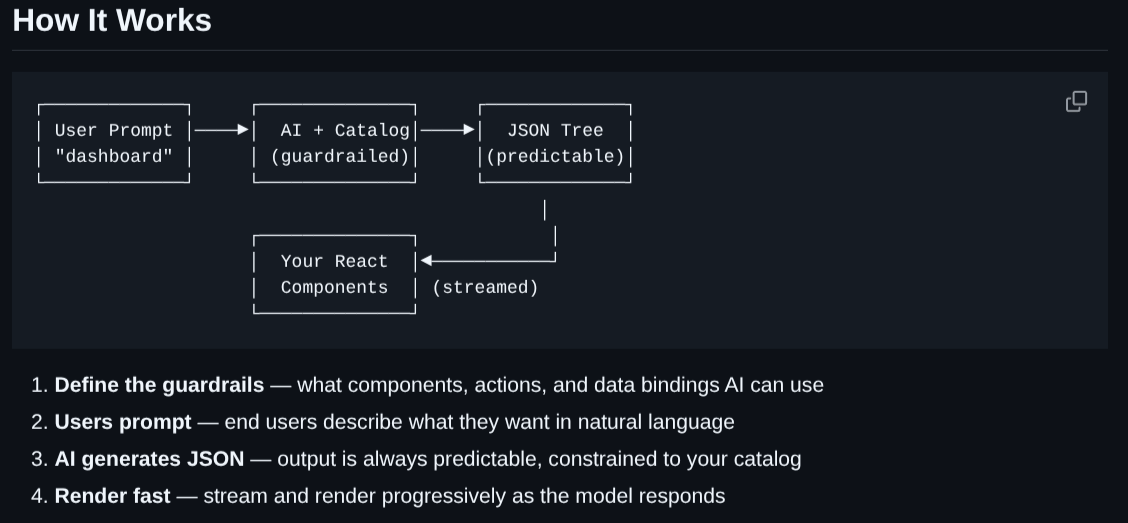
Schema-Safe Streaming: AI output is constrained to a catalog of components you define, ensuring only valid, predictable JSON is generated and rendered.
Progressive Rendering: UI updates stream in real time as the model responds, enabling responsive user experiences for dashboards and data-driven apps.
Guardrails & Validation: Built-in validation, conditional visibility, and rich action support (including confirmation dialogs and callbacks) keep interfaces secure and user interactions safe.
Flexible Integration: Core packages (
@json-render/core,@json-render/react) support TypeScript and React, with easy hooks for data providers, action handlers, and custom component registries.Open Source Momentum: With over 7,800 GitHub stars and active contributions, json-render is quickly gaining traction among teams building next-gen AI interfaces.
Explore the repo, demos, and documentation to see json-render in action:
Top News of the week
Anthropic Unveils New Economic Primitives to Track Real-World AI Impact

Anthropic has released its fourth Economic Index, introducing a new set of "economic primitives"—core metrics designed to measure and understand the real-world adoption and economic effects of AI, specifically through its Claude models. This release marks a significant advance in how researchers, policymakers, and industry professionals can track not just where and how AI is used, but also its tangible impact on productivity, job tasks, and skill requirements across the globe.
The new primitives—task complexity, skill level, use case (work, education, personal), AI autonomy, and task success—enable a more granular analysis of AI’s economic footprint. For example, the report finds that Claude speeds up complex tasks (those requiring college-level education) by a factor of 12, with productivity gains concentrated among white-collar professions. However, the data also suggest a potential "deskilling" effect, as AI covers higher-skilled tasks, and highlight persistent disparities in AI adoption by country and occupation. Notably, augmentation (AI assisting humans) has overtaken automation as the most common use pattern on Claude.ai.
These insights provide a new empirical foundation for understanding how AI is reshaping the workforce and productivity. The report is expected to inform future research and policy, especially as AI capabilities and adoption continue to accelerate.
Also in the news
Anthropic Unveils 'Assistant Axis' for Safer AI Personas
Anthropic’s latest interpretability research introduces the "Assistant Axis," a universal activation direction in large language models that governs assistant-like behavior. By mapping how models drift between personas, Anthropic demonstrates how "activation capping" can reduce harmful outputs without retraining. This breakthrough offers practical tools for stabilizing AI assistants and mitigating risks from persona drift, advancing both safety and transparency in LLM deployments.
Anthropic Unveils 'Assistant Axis' for Safer AI Personas
Anthropic’s latest interpretability research introduces the "Assistant Axis," a universal activation direction in large language models that governs assistant-like behavior. By mapping how models drift between personas, Anthropic demonstrates how "activation capping" can reduce harmful outputs without retraining. This breakthrough offers practical tools for stabilizing AI assistants and mitigating risks from persona drift, advancing both safety and transparency in LLM deployments.
Google Gemini Launches Personal Intelligence for Cross-App Reasoning
Google has launched Personal Intelligence in Gemini, enabling the AI to reason across Gmail, Photos, YouTube, and Search for more personalized responses. This opt-in beta, available to U.S. AI Pro and Ultra subscribers, allows Gemini to retrieve and synthesize data from multiple Google apps in real time. Privacy controls ensure users can choose which apps to connect, and personal data is not used for model training, marking a new step in context-aware AI assistance.
Tip of the week
Supercharge Your AI Agents with Vercel's Open-Source Skills
Want to make your AI coding agents smarter and more versatile? Vercel's open-source Agent Skills ecosystem lets you instantly add reusable, modular capabilities to your agents—no heavy lifting required.
What it is: A collection of plug-and-play instruction packs (skills) for AI agents, covering React/Next.js best practices, web design guidelines, and instant Vercel deployments.
How to use: Install with a single command:
Why it's useful:
Rapidly extend agent functionality with proven, community-driven modules.
Boost code quality, performance, and deployment speed—especially for React, Next.js, and web projects.
Share and customize skills across teams for consistent, scalable workflows.
Key benefit: Deploy apps, audit code, and enforce best practices directly from your agent’s conversation—no manual setup needed.
Try this when you want to automate code reviews, optimize performance, or deploy projects with minimal effort.
We hope you liked our newsletter and you stay tuned for the next edition. If you need help with your AI tasks and implementations - let us know. We are happy to help