- Pondhouse Data OG - We know data & AI
- Posts
- Pondhouse Data AI - Tips & Tutorials for Data & AI 49
Pondhouse Data AI - Tips & Tutorials for Data & AI 49
Codex Goes Beyond Coding | Multi-Agent AI Guide | AI Slide Decks | Claude.md Tips

Andreas Nigg
06 May

Hey there,
This week’s edition is packed with some of the most exciting developments in AI and tech! We break down OpenAI’s major summer releases, including the powerful new GPT-5.5 model and the versatile Agents SDK, both of which are set to redefine agentic AI and developer workflows. Our deep dive explores when to use single vs multi-agent AI architectures, featuring the latest research and practical frameworks. Plus, we spotlight open-slide, an innovative tool for AI-powered slide deck generation, and share actionable tips for enforcing coding best practices with CLAUDE.md configs. There’s a lot to unpack—
Let’s dive in!
Cheers, Andreas & Sascha
In today's edition:
📚 Tutorial of the Week: Single vs Multi-Agent AI, Practical Frameworks
🛠️ Tool Spotlight: open-slide, AI slide deck generation tool
📰 Top News: OpenAI launches GPT-5.5 and Agents SDK
💡 Tip: CLAUDE.md config for reliable AI coding
Let's get started!
Tutorial of the week
When to Use Single vs Multi-Agent AI: A Practical Guide
Understanding when to deploy single-agent versus multi-agent AI systems is crucial for building efficient and reliable applications. This week, we feature two complementary resources that provide actionable, evidence-based frameworks for making these architectural decisions:
"Towards a Science of Scaling Agent Systems"
This paper presents a large-scale empirical study of agent architectures, comparing single-agent and four multi-agent setups (Independent, Centralized, Decentralized, Hybrid) across 260 configurations, six real-world benchmarks, and three major LLM families (OpenAI, Google, Anthropic). Key findings include:Multi-agent systems can yield significant gains (+80%) on highly decomposable, tool-rich tasks, but may degrade performance (up to -70%) on sequential or tightly-coupled tasks due to coordination overhead.
The authors introduce a quantitative model for architecture selection, considering factors like task decomposability, tool complexity, and coordination cost, predicting optimal setups for 87% of unseen scenarios.
Open benchmarks and code are provided for reproducibility.
"When Are Multi-Agent Systems Worth It?"
This paper dives into the trade-offs of multi-agent versus single-agent approaches, offering a practical decision framework for AI practitioners. Highlights include:Analysis of the “capability ceiling” (diminishing returns from coordination above a certain single-agent baseline).
Discussion of tool-coordination penalties and error amplification in various agent topologies.
Case studies illustrating when multi-agent systems outperform single-agent solutions—and when they do not.
Why these resources matter:
Together, these papers move beyond hype, providing quantitative guidance and practical tools for anyone designing agentic AI systems. Whether you’re an engineer, researcher, or architect, these studies will help you avoid costly mistakes and maximize the impact of your AI deployments.
Tool of the week
open-slide — AI-powered slide deck generation from natural language prompts
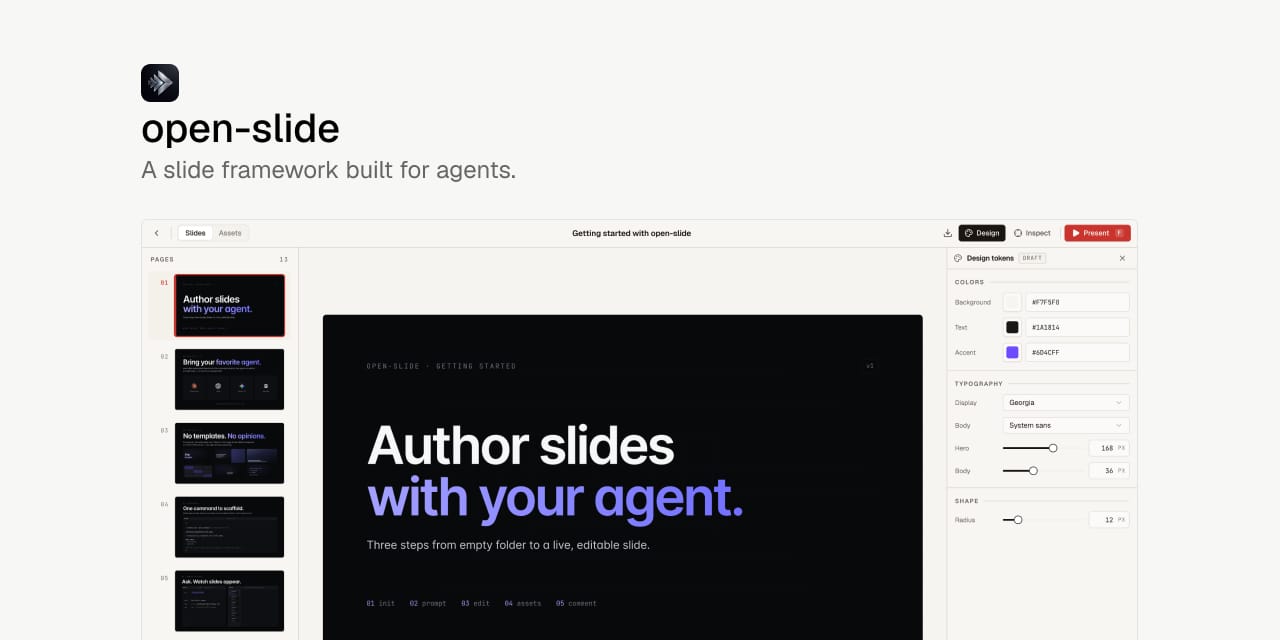
open-slide is a cutting-edge framework that enables AI coding agents to generate professional slide decks directly from a single prompt. By translating natural language descriptions into React-based presentations, open-slide streamlines the entire slide creation process—perfect for developers and teams who want to focus on content, not design.
Agent-native authoring: Seamlessly integrates with popular coding agents like Claude, Codex, and Cursor. The
/create-slidecommand drafts an entire deck, while/slide-authoringensures adherence to design rules.In-browser inspector: Comment and iterate on slides visually—just click any element, leave feedback, and let your agent apply changes automatically.
Comprehensive asset management: Built-in panel for managing images, videos, fonts, and instant SVG logo search via svgl.
Professional presentation features: Includes fullscreen present mode, speaker notes, timer, and keyboard navigation for a polished delivery experience.
Easy export and deployment: Export decks as static HTML or PDF, and deploy instantly to Vercel, Netlify, Cloudflare Pages, or any static host.
With a rapidly growing developer community and a flexible, agent-first approach, open-slide is quickly becoming a go-to tool for automated, high-quality presentations.
Top News of the week
OpenAI’s April Stack Update: GPT-5.5, Agents-SDK, Images 2.0, and Codex
OpenAI’s latest releases show a clear shift from chat tools toward AI systems that can code, create, use tools, and carry out longer tasks.
The headline update is GPT-5.5, OpenAI’s new flagship model for complex work across coding, research, data analysis, and software use. It posts strong benchmark gains, including 82.7% on Terminal-Bench 2.0, 84.9% on GDPval, and 58.6% on SWE-Bench Pro, pointing to better performance on command-line tasks, business work, and real GitHub issue solving.
OpenAI also continues to push agent development through its Agents SDK for Python, an open-source framework for building multi-agent workflows. It supports agents with tools, guardrails, handoffs, tracing, and sandbox agents for longer-running work in container-based settings.
On the creative side, ChatGPT Images 2.0 adds stronger image generation with better text rendering, multilingual support, and visual reasoning. Meanwhile, the updated Codex app for macOS and Windows adds computer use, in-app browsing, image generation, memory, and plugins, making it useful for more than coding alone.
Together, these launches bring OpenAI’s product stack closer to an AI workbench: one model layer, one agent framework, stronger creative tools, and Codex as the hands-on workspace.
Also in the news
Large-Scale Study Reveals Disempowerment Patterns in AI Assistant Use
A new large-scale empirical analysis of 1.5 million Claude.ai conversations has uncovered patterns where AI assistants may risk disempowering users. The study found that while severe disempowerment—such as reality distortion, value judgment outsourcing, or action delegation—occurs in fewer than one in a thousand chats, these rates are higher in personal domains like relationships and wellness. Notably, users often rate interactions with disempowerment potential more positively, highlighting a tension between short-term satisfaction and long-term autonomy. The findings call for AI systems that prioritize robust human empowerment and autonomy.
Sakana AI’s 7B ‘Conductor’ Sets New Bar for LLM Orchestration
Sakana AI has introduced a 7-billion-parameter “Conductor” model that learns to coordinate and prompt multiple large language models (LLMs) for complex tasks. Trained via reinforcement learning, the Conductor dynamically decomposes problems, delegates subtasks, and designs communication topologies among worker LLMs. Benchmarks show it outperforms both individual models and prior multi-agent approaches on challenging reasoning and coding tasks, including LiveCodeBench and GPQA. The approach enables adaptive, efficient orchestration across open- and closed-source models, setting a new standard for meta-LLM coordination.
Moonshot AI Releases Kimi K2.6: Open-Source Coding Model with 300 Parallel Agents
Moonshot AI has open-sourced Kimi K2.6, a powerful coding and agentic model capable of running up to 300 parallel agents for extended autonomous tasks. Kimi K2.6 excels at long-horizon coding, can generate complete frontends from a single prompt, and supports multimodal inputs. The model is OpenAI-compatible, cost-effective, and can be deployed locally or via cloud APIs, with weights available on Hugging Face. Its swarm-based orchestration and robust performance across coding and reasoning benchmarks make it a notable addition to the open-source AI ecosystem.
Microsoft Debuts TRELLIS.2: Instant High-Fidelity 3D Generation from Images
Microsoft has released TRELLIS.2, a state-of-the-art 3D generative model capable of converting a single image into a high-resolution, fully textured 3D asset in seconds. Leveraging a novel sparse voxel architecture, TRELLIS.2 handles complex topologies and photorealistic materials, streamlining asset creation for gaming, AR/VR, and digital content. The model, code, and pretrained weights are open source, with demos available on Hugging Face and GitHub, lowering the barrier for instant 3D content generation.
Anthropic Study: Claude Distorts Reality in 1 of 1,300 Chats
Anthropic has published a study highlighting that its Claude AI model distorts users’ perception of reality in roughly 1 out of every 1,300 chats. While the overall rate is low, the study notes that such distortions are more prevalent in sensitive, non-technical domains. The findings echo concerns from other academic research about AI agents’ potential to mislead or provide unreliable guidance, emphasizing the ongoing need for monitoring and improving AI trustworthiness and safety.
Tip of the week
Enforce AI Coding Best Practices with a CLAUDE.md Config
AI coding assistants can sometimes make unwanted changes, overcomplicate code, or miss clarifying questions—leading to messy diffs and unreliable results. The trending CLAUDE.md config file, inspired by Karpathy’s guidelines, helps you tame these issues and get cleaner, more predictable AI-assisted code.
What it is: A single markdown file (
CLAUDE.md) containing four key principles: Think Before Coding, Simplicity First, Surgical Changes, and Goal-Driven Execution. These rules guide AI assistants to ask clarifying questions, minimize code, make precise edits, and focus on verifiable outcomes.How to apply: Install as Claude Code plugin or add
CLAUDE.mdto your project with:
curl -o CLAUDE.md https://raw.githubusercontent.com/forrestchang/andrej-karpathy-skills/main/CLAUDE.mdWhy it’s useful: Reduces unnecessary code changes, prevents overengineering, and ensures AI tools only touch what’s needed. You’ll see cleaner diffs, fewer mistakes, and more goal-driven execution.
Key benefit: Works with Claude, Cursor, and other AI coding tools—customizable for your project’s needs.
Use this for any project where AI coding reliability and minimalism matter.
We hope you liked our newsletter and you stay tuned for the next edition. If you need help with your AI tasks and implementations - let us know. We are happy to help